

























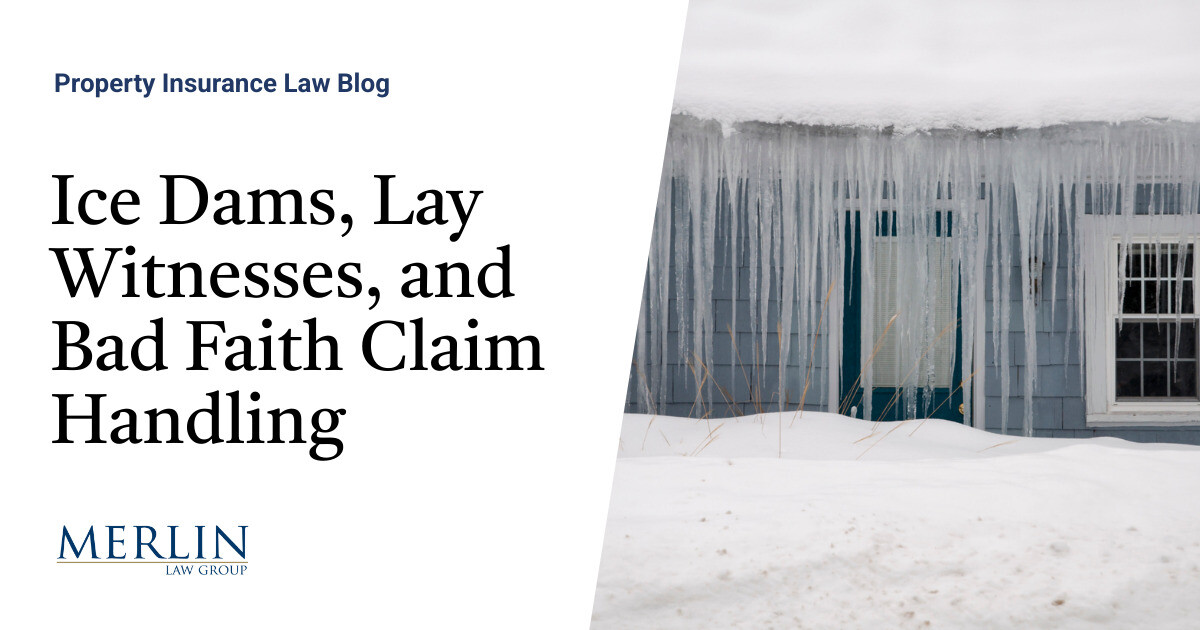







Ice dam claims are deceptively simple and routinely mishandled. Snow builds up, heat differentials cause melting and refreezing, water intrudes where it should not, and damage appears shortly thereafter. Yet insurers often try to turn these straightforward facts into complex engineering disputes or, worse, into exclusion scavenger hunts. A Utah federal court decision involving Travelers is a textbook example of why that approach fails. 1
The case arose from damage to elevated decks caused by ice damming. The policyholder observed ice dams forming, noticed cracking and damage within weeks, and confirmed the decks had been in good condition beforehand. Travelers denied the claim. First, it said the damaged structures were “patios” and therefore excluded. Then, after more than a year and without conducting a meaningful reinspection, it abandoned that explanation and shifted to wear and tear, deterioration, seepage, settling, expansion, and latent defect exclusions. By the time the case reached summary judgment, Travelers was asserting a laundry list of exclusions without clearly committing to any single cause of loss.
That strategy backfired.
Ice dam cases are not exotic. They are timing-driven. What existed before winter matters. What happened during freezing conditions matters. What changed shortly thereafter matters. Those facts often come not from engineers, but from the people who live in the buildings. Courts understand this.
In this case, the insurer tried to discredit the policyholder’s testimony by arguing that he was not an expert and could not opine on causation. The court rejected that argument outright. A homeowner does not need an engineering degree to testify that ice dams formed, that damage appeared shortly afterward, and that the damage did not exist before. That is not expert testimony. That is personal knowledge. It is more than enough to create a genuine dispute of fact. One wonders why Travelers either dismissed these facts or failed to find them through a proper investigation.
Travelers’ own engineering report compounded the problem. The engineer never inspected the property and relied solely on photographs taken long after the loss. Even then, the report concluded only that the damage “likely” occurred over time and expressly could not rule out ice damming. That single concession was fatal to Travelers’ argument that the exclusions applied as a matter of law. Exclusions do not apply in the abstract. They apply only if the excluded peril actually caused the loss. When the insurer’s own evidence cannot eliminate the covered cause, summary judgment is off the table.
The bad faith analysis is just as instructive. Utah law imposes an implied duty of good faith and fair dealing requiring insurers to diligently investigate claims, fairly evaluate them, and act promptly and reasonably in denying or paying benefits. Insurers often invoke the “fairly debatable” doctrine as if it were a get-out-of-jail-free card. It is not. Utah courts have been clear that a claim is not fairly debatable simply because an insurer says so. The question is whether reasonable minds could differ as to whether the insurer met its obligations at the time of denial.
Travelers offered almost no evidence of what it actually did during the claim process to investigate or evaluate the loss. There was no meaningful onsite inspection beyond an initial visit tied to a different claim. There was no contemporaneous expert analysis prior to the denial. There were shifting explanations, long periods of silence, and no clear articulation of why any particular exclusion applied. The court correctly held that reasonable jurors could conclude that this conduct fell short of Utah’s bad faith standards. That alone required denial of summary judgment.
The broader lesson is one I have seen repeated for decades. Insurers lose credibility when they change their stories. They lose when they rely on their typical cast of post-litigation experts to justify pre-litigation decisions. They lose bad faith motions when they cannot show a disciplined, timely, honest, and transparent claims process. Many insurers now act in bad faith by failing to promptly turn over all drafts of expert reports or underwriting reports about pre-loss conditions of the property.
Ice dam cases, in particular, expose these weaknesses. They are fact-driven, seasonal, and often observable without specialized testing. Lay witnesses matter because they anchor the timeline. Public adjusters matter because they document conditions the insurer chose not to inspect. Courts matter because they remind everyone that exclusions are not weapons to be deployed opportunistically and in a shotgun manner. Exclusions are contractual provisions that should be capable of being proven at the time of denial.
Thought For The Day
“The truth does not change according to our ability to stomach it.”
— Flannery O’Connor
1 Andrew v. Travelers Home & Marine Ins. Co., No. 1:20-cv-00179, 2022 WL 2181662 (D. Utah June 16, 2022). See also, Travelers Motion for Summary Judgment, policyholder’s Opposition to Motion for Summary Judgment, and Affidavit of Chad Andrews.