




























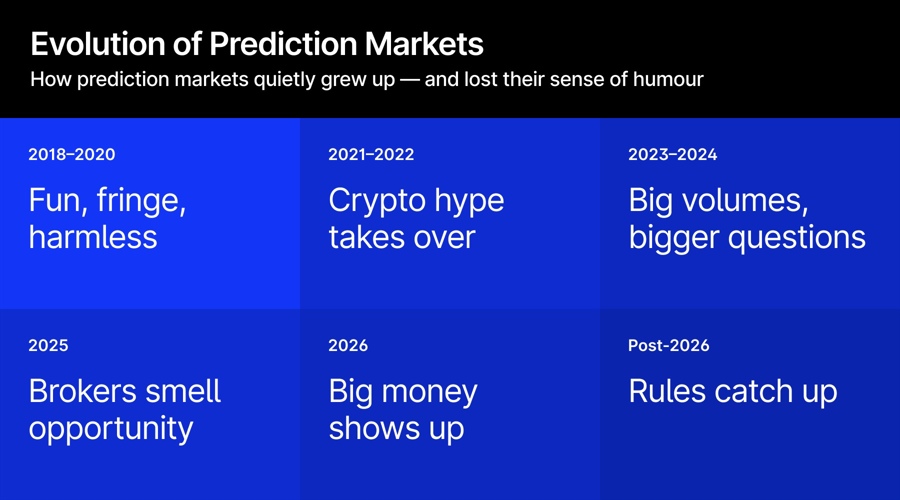



Prediction markets are swiftly transforming from an exotic tool for crypto geeks into a fully fledged financial asset, with a clear ambition to attract institutional capital.
This week’s developments — from regulatory disputes to new product launches — serve as a reminder that prediction markets are no longer just fun and games.
What once felt like a quirky way to bet on election results, Oscar winners, or a collective “when moon” is starting to look distinctly less entertaining and more like Treasury bills or even subordinated perpetual callable bonds (if you’ll pardon my French).
As margin trading, clearing structures, and broker integrations come into play, the industry is being forced to shed its novelty status. And with institutional capital comes regulatory scrutiny — followed by a far less forgiving operating environment.
This week’s headlines capture that transition in real time. Products that once thrived on humour, memes, and cultural events are now discussed in the language of derivatives law, market surveillance, and consumer protection. For regulators, brokers, and exchanges alike, prediction markets are no longer amusing curiosities — they are financial instruments with real risk, real money, and real consequences.
Institutional Twist
Prediction markets are making a deliberate push toward institutional finance, signalling a shift away from fully collateralised, retail-friendly products.
This week, Kalshi confirmed it is seeking regulatory approval to introduce margin trading, with discussions ongoing at the CFTC. The proposed structure would mirror traditional futures, allowing institutional investors to deploy capital more efficiently.
🫣 Kalshi reportedly met with the CFTC recently to discuss offering margin trading on prediction market platforms. The proposal would initially target institutional investors, allowing them to take positions w/o posting full collateral. Unclear if regulators will approve request. pic.twitter.com/Gk7AwI6glz
— Schaeffer’s Investment Research (@schaeffers) February 6, 2026
In parallel, Crypto.com launched a US-focused prediction platform, explicitly positioned within its regulated derivatives framework, including plans for margin-based contracts.
Margin and clearing are becoming the dividing line between prediction markets as entertainment and prediction markets as financial infrastructure. In practice, the institutional turn reflects a simple reality: retail money is too small and too unreliable to carry the market forward.
The shift comes even as Shayne Coplan, CEO of Polymarket, continues to frame prediction markets as a future “global truth machine,” rather than just another financial product.
Regulatory Pushback
While prediction platforms try to attract institutions, regulators struggle to agree on what these markets are and how to treat them.
Commodity Futures Trading Commission (CFTC) effectively signalled support for “lawful innovation.” The regulator dropped the proposals that would have restricted sports- and politics-based event contracts.
However, not everyone is comfortable with this approach. Ahead of the Super Bowl, New York Attorney General Letitia James warned consumers about prediction markets. She called them bets masquerading as regulated event contracts and raising concerns about consumer protection and insider trading.
This contrast highlights a growing fault line: while federal regulators discuss clearer rules and market development, state authorities treat prediction markets as unregulated gambling. Regulatory stakes are high as trading volumes rise and products become increasingly financial.
Brokers Move In
This week underscored how event-based trading is increasingly being packaged as broker-ready infrastructure rather than a niche consumer product.
The most visible signal came from Plus500, which rolled out prediction markets for US retail clients through a partnership with Kalshi. The launch framed event contracts as a regulated extension of a traditional brokerage offering — and was rewarded by investors with a record high in Plus500’s share price.
Behind the scenes, technology providers are moving to make prediction markets easier to deploy. Leverate is preparing to unveil a prediction market technology stack for brokers, while Devexperts has already introduced tools allowing CFD brokers and exchanges to build event-based contracts without developing the infrastructure in-house.
The message is clear: prediction markets are being productised as plug-ins for existing trading environments.
Signs of crowding are also emerging. A new venture, Lumina Markets — linked to Thomas Peterffy — is preparing to enter the space, while crypto platforms are pushing from the other side.
Taken together, these moves suggest prediction markets are no longer fighting for attention — they are fighting for placement inside brokerage stacks. Distribution, infrastructure, and regulatory readiness are becoming more important than novelty.
Bottom Line
What makes this moment uncomfortable is not how fast prediction markets are growing, but how ordinary they are starting to look. Margin, clearing, broker distribution, and regulatory turf wars — none of this is funny, novel, or particularly creative.
It is simply how financial markets behave once real money shows up.
The irony is hard to miss. Products that once thrived on memes, cultural trivia, and playful speculation are now being discussed in the same breath as derivatives rules and compliance frameworks.
In trying to become taken seriously, prediction markets are succeeding — at the cost of the very irrelevance that made them interesting in the first place.
For now, the industry is still trying to have it both ways: the accessibility and excitement of entertainment, with the balance sheets and credibility of finance. History suggests that this balancing act rarely lasts. And when it ends, prediction markets may discover that becoming “just another financial product” was the least predictable outcome of all.
This article was written by Tanya Chepkova at www.financemagnates.com.
Source link